
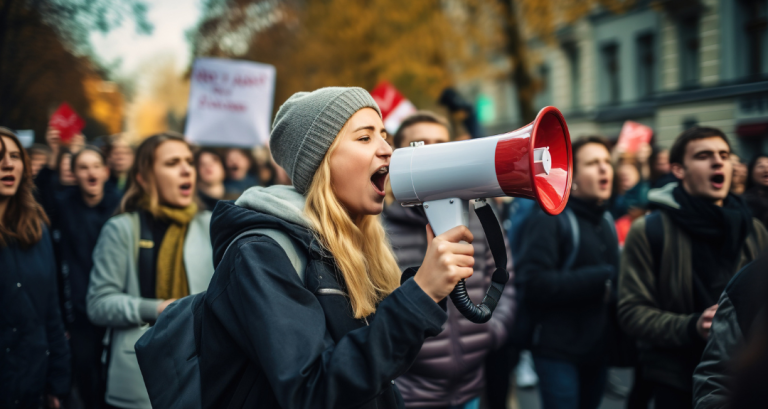
Honoring The Freedom of Speech on America’s 250th Anniversary
This July marks 250 years since the signing of the greatest political document in history, the Declaration of Independence. Given that our nation has endured for a quarter of a millennium, it is good and right for us to revisit one of our bedrock freedoms—the freedom of speech.
This precious First Amendment freedom was codified into our founding documents 15 years after the signing of the Declaration, when the Bill of Rights was added to the Constitution in 1791. But despite its prominent position in the very first amendment, the freedom of speech has consistently been one of the most misunderstood of all of our precious liberties…case in point: protesters who recently invaded and disrupted a church service in St. Paul, Minnesota.
As you may have seen, former CNN anchor Don Lemon was immediately on-site during the church takeover (with obvious foreknowledge of the plan) and proceeded to confront Cities Church pastor Jonathan Parnell and other worshippers on camera. In one video, he responded to Pastor Parnell’s depiction of the church takeover as “shameful” with a shockingly ignorant (or dishonest) statement for someone who was once a network news anchor: “There’s a Constitution and a First Amendment, and freedom of speech and freedom to assemble and protest”—obviously asserting that the action of the protesters was a legitimate exercise of their constitutional rights.
I would bet that many of my former high school students could spot the error in his logic (don’t let me down, Los Altos Civics alumni!). I would hope they would tell me what I taught them: that the freedoms included in the Bill of Rights are designed to protect us from the actions of government. They do not apply to private disputes. These protesters are free to protest on public sidewalks without being punished or censored. But the freedom of speech never includes the right to enter private property and exercise a heckler’s veto over a worship service. As Cities Church points out in their response to the event, “Invading a church service…is protected by neither the Christian Scriptures nor the laws of this nation.” As a result, these protesters are at high risk of being prosecuted for their illegal actions.
Could you imagine a world in which the Constitution guaranteed us the right to enter private spaces and disrupt any meeting we didn’t like? That is not the rule of law, but the rule of the mob. As educators, let’s use incidents like these to teach our students the true understanding of our rights as citizens.
Despite the challenges being faced in Minnesota, there is good news from around the nation for educators and students in public schools regarding the definition of freedom of speech.
- Though the ruling is currently set aside awaiting appeal, I am optimistic that the recent decision in Mirabelli v. Olson out of California will ultimately be upheld (join me in praying for just that!). A federal district court in California ruled last month that teachers cannot be compelled to conceal a student’s gender questioning or confusion from parents. If upheld, this ruling will forbid so-called “gender secrecy” policies in California that have perniciously encouraged school districts to socially transition students without their parents’ knowledge. The judge specifically cited the free speech rights of educators as one of the bases for his ruling.
- In Defending Education v. Olentangy, the Sixth Circuit ruled that an Ohio school district can’t prohibit students from “misgendering” other students, explicitly stating that “The school district may not skew this debate [over sex/gender] by forcing one side to change the way it conveys its message or by compelling it to express a different view.” In essence, forcing students to use pronouns inconsistent with someone’s biological sex is requiring them to agree with transgender ideology. The court got this right—that’s exactly why I refuse to list preferred pronouns in my bio.
- Have you ever felt like mandatory “anti-racism” or DEI training required you to violate your rights? You are not alone. Last month, the Eighth Circuit revived a challenge by two Missouri educators in Henderson v. Springfield R-12 School District, who allege that their district’s mandatory “Equity Training” violated their First Amendment rights by compelling speech, engaging in viewpoint discrimination, and creating a chilling effect on their expression. Through interactive sessions, the training required “correct” answers affirming the district’s views on equity, anti-racism, and privilege—labeling whites, men, heterosexuals, Protestants, and the rich as oppressors.
While these battles (and others) to protect our free speech rights continue through the courts, it’s important to remember from recent history why the battle is so important.
Consider the two primary areas where institutions have aggressively suppressed free speech in recent years: COVID policies and gender identity issues.
During the pandemic, it’s well-documented that federal officials heavily pressured social media companies—even threatening regulatory penalties—to censor supposed “misinformation.” Yet many official narratives eventually crumbled. For example, prolonged school closures devastated children’s learning and mental health for minimal public health gains. Natural immunity, initially dismissed in an effort to promote vaccines, often proved equally effective. I vividly recall advocating for teachers who’d recently recovered from COVID (gaining a degree of natural immunity) while their districts stubbornly insisted that they take an experimental vaccine to keep their jobs.
On gender identity, authoritative bodies—medical and professional associations, federal and state governments, school districts—pushed the narrative that minors need (the tragically misnamed) “gender affirming care,” or the likely alternative is suicide. “A live son or a dead daughter” (or vice versa) became the emotional cudgel pressuring parents into experimental hormonal and surgical interventions on their children. Tragically, teachers were fired, and parents lost custody of their children for refusing to go along.
But again, the truth eventually prevailed. The revealing Cass Report demonstrated that “gender affirming care” for minors offered negligible mental health gains while inflicting grave harms, like sterilization. Adding to the scandal, the leaked WPATH Files proved that trans activist doctors knowingly violated ethics to shape global care standards for gender dysphoria. In other words, the Bible was right all along—“male and female He created them.”
The point is obvious: In both recent instances where speech was widely censored, the “official” narratives were proven to be spectacularly wrong in key respects. In a surprising number of cases, the supposed “misinformation” we had to be protected from turned out to be closer to the truth. Entrusting any officials to arbitrate acceptable speech (beyond narrow, historic exceptions like true threats, incitement to violence, obscenity, etc.) is a fool’s errand. It always ends in oppression and abuse.
The power of the freedom of speech is that through open debate, the truth eventually emerges, as Proverbs 18:17 wisely observes: “The one who states his case first seems right, until the other comes and examines him.”
What else motivated the framers to enshrine the freedom of speech in our Constitution? Nearly all of them held the view that we are created in the image of a God who not only speaks, but His words carry the power of creating and transforming. Likewise, as image-bearers, our words to pray or to curse are powerful and central to our unique purpose. The framers were putting legs on the Declaration’s soaring, history-changing, flag-in-the-ground statement that we all have unalienable rights endowed by our Creator. They established that no American government is free to censor or punish our God-given calling to speak…and with our words glorify Him, call everyone to repentance, proclaim the gospel, and extend His rule and reign on the earth. Nearly 250 years later, that is worth celebrating.

David Schmus is the Executive Director of Christian Educators.
Click the button below to learn more about David Schmus.
Free to Teach is written to inform, encourage, and inspire Christian educators serving in our public schools. It should not be construed as legal advice provided by an attorney.
Want More Free to Teach?
Subscribe
Get Free to Teach delivered to your inbox.

4 Responses
Thank you so much for explaining in further detail what our forefathers meant when they added freedom of speech to our Constitution/Bill of Rights. I am sharing this article with other teachers! I am grateful to God to be a part of Christian Educators!
Thanks Lisa! We are so blessed to have you as a member!
Thank you Dave for this excellent article! The detailed information presented clarifies once again the importance of Freedom of Speech for our American people. Thank you also for defining more clearly how in so many instances people have misused this privilege to promote their own social agenda. I appreciate the verse you shared, Proverbs 18:17. What may seem right at first, after cross examination the truth comes out more clearly!
I appreciate the feedback Carla! Blessings to you.